
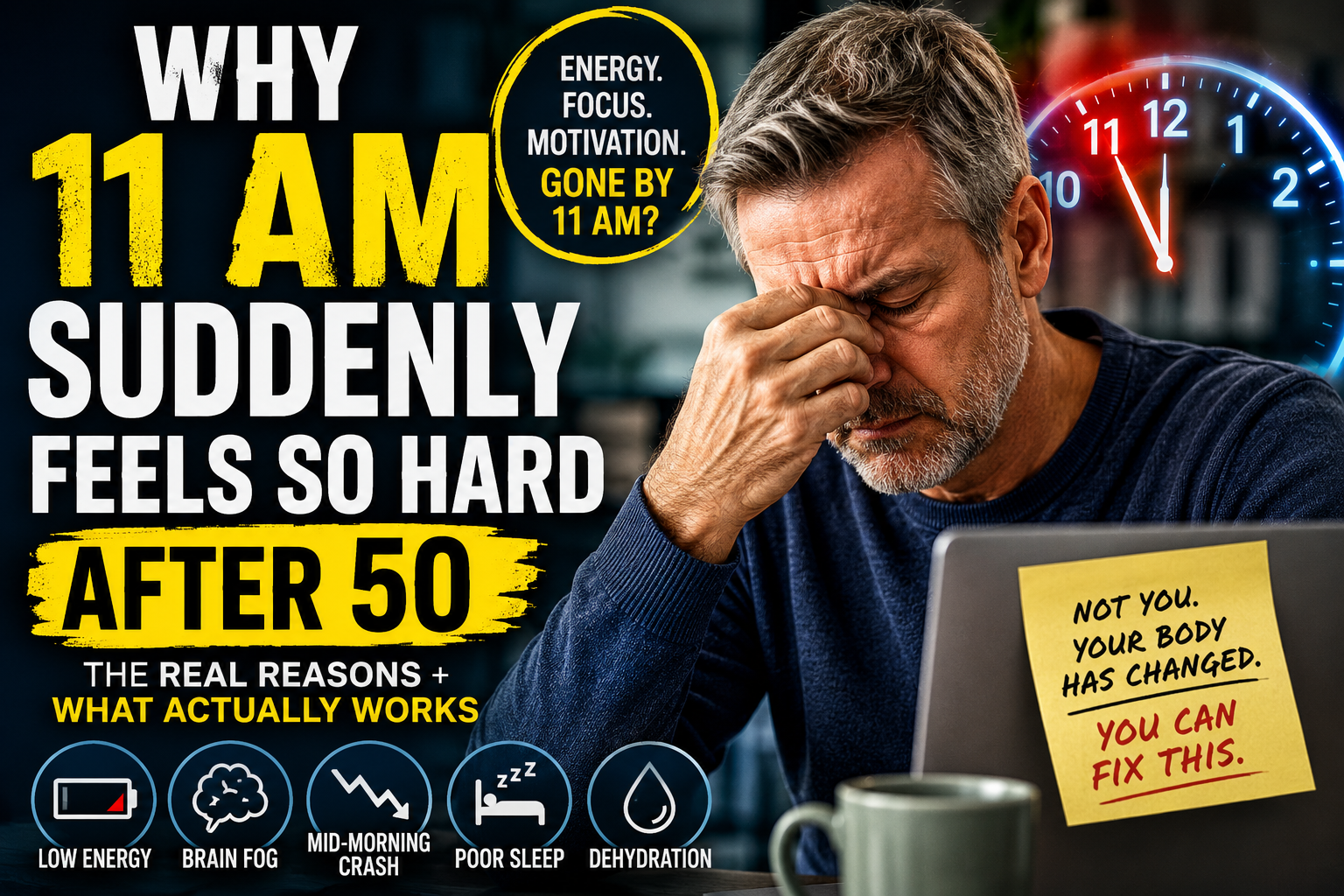
Why 11 AM Suddenly Feels So Hard After 50
Something changes after 50.
You wake up feeling decent. Maybe even motivated. But somewhere around 10:30 or 11 AM… everything shifts.
Your focus fades.
Your motivation drops.
Your body feels heavier.
And suddenly the rest of the day feels like survival mode.
What makes it frustrating is this never used to happen.
You used to power through mornings without thinking about energy, hydration, blood sugar, sleep quality, or protein intake. Now your body plays by different rules.
And the strange part?
Most people blame age itself when the real issue is what aging changes inside the body.
The clock becomes your enemy instead of just a marker.
Why Your Energy Crashes Earlier After 50
Your cortisol pattern changes with age. The morning hormone spike that once carried you through the first half of the day begins to flatten. By mid-morning, your body no longer produces the same natural boost it once did.
Blood sugar regulation changes too. Insulin sensitivity decreases over time. The breakfast that fueled you for years can suddenly leave you drained and foggy before lunch.
Sleep also changes in ways most people do not realize. Even if you spend eight hours in bed, deep restorative sleep decreases with age. You wake up less recovered than you did at 35 or 40, and that deficit often shows up around 11 AM.
This is why so many people over 50 feel like they hit a wall before noon.
The Mid-Morning Coffee Trap After 50
When the crash hits, most people reach for another cup of coffee.
At first, it feels like the answer.
But after 50, caffeine behaves differently inside the body. Your liver processes it more slowly than it used to. That extra coffee at 11 AM can still affect your nervous system late into the evening.
Now you sleep worse.
Then you wake up tired.
Then you need more caffeine the next day.
The cycle quietly repeats itself.
What once felt energizing slowly becomes part of the problem.
Many people over 50 are not actually low on caffeine. They are trapped in a recovery deficit caused by poor sleep and unstable energy patterns.
Muscle Loss Quietly Drains Your Energy
After age 40, adults lose roughly eight percent of muscle mass per decade.
That matters more than most people realize.
Muscle tissue stores glycogen, which helps fuel steady energy throughout the day. Less muscle means fewer energy reserves. Your body simply runs out of fuel faster than it once did.
Mitochondria also decline with age. These tiny power generators inside your cells produce less energy than they used to. Physical stamina decreases, but mental stamina drops too.
That is why even simple tasks can suddenly feel mentally exhausting before lunchtime.
How Breakfast Habits Trigger Energy Crashes After 50
Many people unknowingly create their own 11 AM crash with breakfast.
Toast.
Cereal.
Juice.
Sweet coffee drinks.
Bagels.
These foods spike blood sugar quickly, especially after 50 when insulin response changes.
The result is a rapid energy rise followed by a sharp drop a few hours later.
Most people also eat far too little protein in the morning.
Your body now needs more protein than it did when you were younger. Around 25 to 30 grams at breakfast helps stabilize blood sugar and support muscle maintenance.
Eggs, Greek yogurt, cottage cheese, or protein shakes can make a dramatic difference in how you feel before noon.
Sometimes the fix is simpler than people think.
Why Dehydration Hits Harder After 50
Your body becomes less efficient at recognizing thirst as you age.
That means many people spend the entire morning mildly dehydrated without realizing it.
Even slight dehydration affects focus, circulation, mental clarity, and energy production.
Kidney function also naturally declines over time, making hydration even more important.
The foggy feeling many people experience around 11 AM is sometimes not fatigue at all.
It is dehydration.
Drinking 16 ounces of water immediately after waking can noticeably improve energy and focus throughout the morning.
Coffee does not replace water.
Stress Affects Your Energy Differently Now
Stress recovery changes after 50.
When you were younger, your body bounced back faster after poor sleep, pressure, or emotional stress. Now stress hormones linger longer in your system.
Cortisol patterns become less balanced.
Recovery slows down.
Mental fatigue builds faster.
Even low-grade stress can leave you feeling mentally exhausted by late morning.
This is one reason so many people over 50 feel “off” even when they cannot explain why.
Their nervous system never fully resets.
Vitamin Deficiencies Can Trigger Mid-Morning Fatigue
As you age, your stomach produces less acid. That affects nutrient absorption, especially vitamin B12 and iron.
Both nutrients are directly tied to cellular energy production.
Vitamin D issues also become more common after 50. Even if levels appear normal, your cells may not use vitamin D as efficiently as they once did.
The result can feel like unexplained fatigue, brain fog, poor concentration, and low motivation.
Many people try to solve the problem with caffeine when the real issue may be nutritional.
Sitting Too Long Makes the Crash Worse
One of the biggest hidden energy killers after 50 is inactivity.
If you sit for hours without movement, circulation slows down. Blood flow decreases. Oxygen delivery drops. Your brain becomes less alert.
This often creates the feeling of “hitting a wall” before lunch.
Simple movement changes everything.
Walking for five minutes every hour can dramatically improve circulation and mental clarity.
Stretching.
Standing.
Taking stairs.
Even short movement breaks matter more now than they used to.
What Actually Helps Energy After 50
The good news is this problem is usually fixable.
Small daily changes create huge improvements over time.
Start with these basics:
* Eat 25 to 30 grams of protein at breakfast
* Drink water immediately after waking
* Get sunlight within 30 minutes of waking
* Move every hour
* Reduce late-morning caffeine
* Improve sleep consistency
* Focus on muscle maintenance and walking
Most people do not need extreme solutions.
They simply need to work with the body they have now instead of the body they had at 30.
The Sleep Connection Most People Ignore
Your sleep needs did not disappear after 50.
You still need deep restorative sleep for proper recovery and energy production.
The problem is your body temperature regulation changes with age. Sleeping too warm disrupts deep sleep phases more than it used to.
Even one poor night of sleep can affect energy for several days.
This is why fixing sleep quality often improves morning energy faster than supplements or stimulants.
Start winding down earlier than feels necessary.
Dim lights sooner.
Reduce screen exposure before bed.
Small sleep improvements create noticeable daytime energy improvements.
Final Thoughts
Most people assume losing energy after 50 is just part of getting older.
It is not that simple.
Your body changes.
Your hormones change.
Your sleep changes.
Your recovery changes.
But once you understand what is actually happening, the 11 AM crash stops feeling mysterious.
And in many cases, it becomes manageable.
Sometimes a few small adjustments are enough to help mornings feel normal again.
Related Posts:
- Why Your Energy Drops After 50
- Boost Energy After 50 Naturally
- Why Your Gut Is Draining Your Energy
- Morning Habits That Boost Energy After 50
Frequently Asked Questions
Why do I feel exhausted by 11 AM after turning 50?
Hormone changes, unstable blood sugar, dehydration, poor sleep quality, muscle loss, and stress recovery issues all contribute to mid-morning fatigue after 50.
How much protein should adults over 50 eat at breakfast?
Most experts recommend around 25 to 30 grams of protein at breakfast to help stabilize blood sugar, support muscle maintenance, and improve energy levels.
Can dehydration cause fatigue before noon?
Yes. Mild dehydration affects circulation, focus, and mental clarity. Many adults over 50 experience weaker thirst signals and may not realize they are dehydrated.
Does caffeine affect older adults differently?
Yes. Caffeine clears more slowly from the body after 50, which can disrupt sleep and create a cycle of fatigue and dependence on more caffeine.
What helps improve energy naturally after 50?
Better sleep, higher protein intake, hydration, sunlight exposure, regular movement, stress management, and muscle maintenance all support more stable energy levels.