
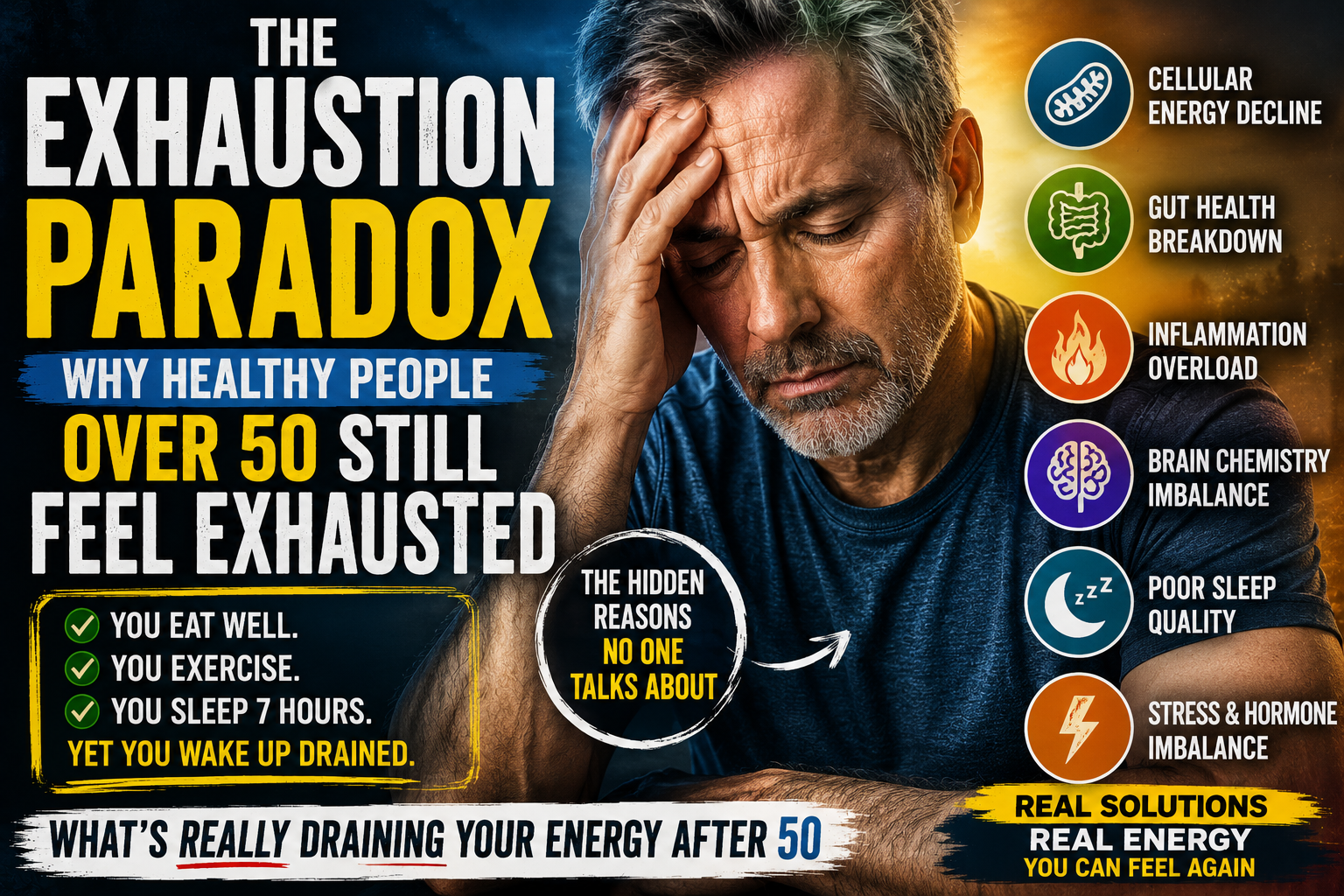
The Exhaustion Paradox: Why Healthy People Over 50 Still Feel Drained
You eat better than most people.
You try to stay active.
>You take vitamins.
>You go to bed at a reasonable hour.
So why do you still wake up exhausted?
Why does your body feel drained before the day even starts?
For many people over 50, this becomes deeply frustrating because they are doing everything “right”… yet their energy keeps disappearing anyway.
And eventually they start wondering:
Is this just aging…
or is something deeper happening inside the body?
The truth is exhaustion after 50 is often far more complicated than simply needing more sleep.
Your body changes at the cellular level.
>Your recovery slows down.
>Your gut changes.
Inflammation increases.
Hormones shift.
And the systems responsible for producing energy no longer work the way they once did.
That is why healthy people can still feel completely drained.
The Hidden Cellular Breakdown Draining Your Energy
Your body creates energy through tiny structures inside your cells called mitochondria.
Think of them as microscopic power plants.
They convert food and oxygen into usable energy every second of the day.
But after 50, mitochondrial efficiency naturally declines.
This happens even if you eat healthy.
Even if you exercise.
Even if your blood work looks “normal.”
At first the changes are subtle.
You recover slower after activity.
You need more rest than before.
Simple tasks feel strangely draining.
Over time, the decline becomes harder to ignore.
Your muscles feel heavier.
Your brain feels slower.
Mental focus becomes inconsistent.
Most people assume they just need more sleep.
But exhaustion caused by poor cellular energy production cannot always be fixed with rest alone.
The problem exists deeper inside the body.
The Gut Health Problem Quietly Stealing Your Energy
Most people never connect gut health with fatigue.
But your digestive system influences energy far more than most people realize.
Your gut contains trillions of bacteria that help regulate inflammation, nutrient absorption, metabolism, and even brain chemistry.
Some of these bacteria produce compounds that directly support mitochondrial energy production.
One important compound is butyrate.
Butyrate helps fuel healthy cells and supports energy metabolism. As gut balance changes with age, butyrate production often declines.
That means your cells receive less support even if your diet looks healthy on paper.
The gut also helps produce B vitamins used for energy conversion.
When gut function weakens, your body struggles to extract and use nutrients efficiently.
You may be eating well…
but your body is not fully using what you consume.
Many people discover how gut health impacts energy levels only after years of unexplained fatigue.
Why You Feel Tired Even After Sleeping
One of the most frustrating parts of exhaustion after 50 is waking up tired despite getting enough sleep.
The issue is often not sleep quantity.
It is sleep quality.
As you age, deep restorative sleep naturally declines.
You sleep lighter.
>You wake up more easily.
>You spend less time in deep recovery stages.
This affects everything:
* Cellular repair
* Hormone balance
* Brain recovery
* Muscle recovery
* Nervous system regulation
You may technically sleep seven hours…
but still wake up feeling like your body never fully recharged.
Poor sleep quality also increases inflammation and stress hormone production, making daytime fatigue even worse.
How Inflammation Quietly Steals Your Energy
Inflammation drains enormous amounts of energy.
And most people over 50 have more inflammation than they realize.
The difficult part is inflammation does not always feel dramatic.
Sometimes it shows up as:
* Brain fog
* Heavy fatigue
* Poor motivation
* Slower recovery
* Stiff joints
* Afternoon crashes
Your immune system stays partially activated all the time.
That constant internal stress consumes energy around the clock.
The causes vary from person to person:
* Poor sleep
* Stress
* Processed foods
* Gut imbalance
* Sugar
* Environmental toxins
* Sedentary lifestyles
Your body works overtime trying to manage all of it.
That is exhausting.
Many people addressing gut balance and inflammation together notice energy improvements surprisingly quickly.
Why Healthy People Still Feel Mentally Exhausted
Fatigue is not always physical.
Sometimes it feels mental first.
You struggle to focus.
You lose motivation.
Simple tasks feel overwhelming.
Your brain feels foggy before noon.
This often connects back to neurotransmitters like serotonin and dopamine.
Your gut helps produce these chemicals.
When gut health weakens, neurotransmitter production can suffer too.
That affects:
* Mood
* Motivation
* Focus
* Drive
* Mental energy
This creates a confusing situation.
Your blood tests may look normal.
You may appear healthy to everyone else.
Yet internally, your body feels like it is running on empty.
Why Caffeine Stops Working After 50
Most people respond to exhaustion with more caffeine.
At first it helps.
But eventually the effect fades.
You drink coffee…
feel slightly better…
then crash harder later.
Caffeine stimulates stress hormones temporarily.
But if your underlying energy production is struggling, stimulants cannot truly solve the problem.
They only mask it briefly.
Worse yet, caffeine can:
* Disrupt sleep quality
* Increase inflammation
* Stress digestion
* Interfere with recovery
* Increase nervous system stress
The short-term boost often creates bigger long-term fatigue problems.
This is why many people over 50 feel trapped in a cycle of exhaustion and caffeine dependence.
The Recovery Problem Most People Ignore
Recovery changes dramatically after 50.
You notice it slowly.
A busy day wipes you out longer.
Exercise soreness lasts longer.
Stress lingers longer.
Sleep recovery feels incomplete.
You wake up tired…
push through the day…
then collapse by evening.
And the cycle repeats itself over and over.
This happens because your body no longer repairs and restores itself as efficiently as it once did.
Recovery becomes slower at the cellular level.
Your body functions like an orchestra where the musicians can no longer hear each other clearly.
Everything still works…
just not smoothly anymore.
Why Standard Blood Tests Often Miss the Real Problem
This frustrates many people the most.
You go to the doctor.
You run blood work.
Everything comes back “normal.”
But you still feel exhausted every day.
Standard blood tests do not measure many of the systems involved in energy production.
They rarely fully evaluate:
* Mitochondrial function
* Gut bacteria balance
* Cellular inflammation
* Neurotransmitter production
* Recovery efficiency
So people leave feeling confused.
They know something feels wrong…
but nothing obvious appears on paper.
The Hormone Shift Behind Low Energy After 50
Hormones also play a major role in exhaustion after 50.
Testosterone declines.
Estrogen shifts.
Cortisol patterns change.
Growth hormone decreases.
These changes affect:
* Muscle maintenance
* Recovery
* Sleep
* Metabolism
* Motivation
* Energy stability
Your body now requires more recovery while simultaneously becoming less efficient at producing it.
That mismatch creates chronic fatigue for many healthy adults over 50.
What Actually Helps Restore Energy After 50
The good news is this:
Exhaustion after 50 is not always something you simply “accept.”
Supporting the body properly can create significant improvements.
Focus on:
* Gut health
* Sleep quality
* Daily movement
* Hydration
* Inflammation reduction
* Stress management
* Muscle maintenance
* Recovery habits
* Protein intake
* Reducing processed foods
Small improvements in several areas often create larger energy gains than chasing one “miracle fix.”
The body wants to heal.
It simply needs the right support.
Final Thoughts
Many healthy people over 50 feel exhausted not because they are lazy…
but because their body is fighting hidden internal stressors they cannot see.
Cellular decline.
Gut imbalance.
Inflammation.
Poor recovery.
Hormone changes.
Sleep disruption.
These problems quietly drain energy over time.
The good news is once you begin understanding what is actually happening inside the body, exhaustion starts making a lot more sense.
And in many cases, energy can improve far more than people expect.
Related Posts:
- Why Your Gut Is Draining Your Energy
- Why Your Energy Drops After 50
- Morning Habits That Boost Energy After 50
- Natural Energy Without Coffee
Frequently Asked Questions
Why do healthy people over 50 still feel exhausted?
Healthy adults over 50 can still experience fatigue due to inflammation, poor gut health, mitochondrial decline, hormone changes, poor recovery, and disrupted sleep quality.
Can gut health really affect energy levels?
Yes. Your gut helps regulate nutrient absorption, inflammation, neurotransmitter production, and cellular energy support. Poor gut balance can significantly impact daily energy levels.
Why do I wake up tired even after sleeping?
Sleep quality often declines with age. You may spend less time in deep restorative sleep stages, leading to incomplete recovery and ongoing fatigue.
Why does caffeine stop helping after 50?
Caffeine only temporarily stimulates energy. Over time it can worsen sleep quality, stress hormones, inflammation, and nervous system fatigue, making exhaustion worse long term.
What are natural ways to improve energy after 50?
Improving gut health, reducing inflammation, increasing movement, supporting sleep quality, staying hydrated, managing stress, and eating enough protein can all help improve energy naturally.