
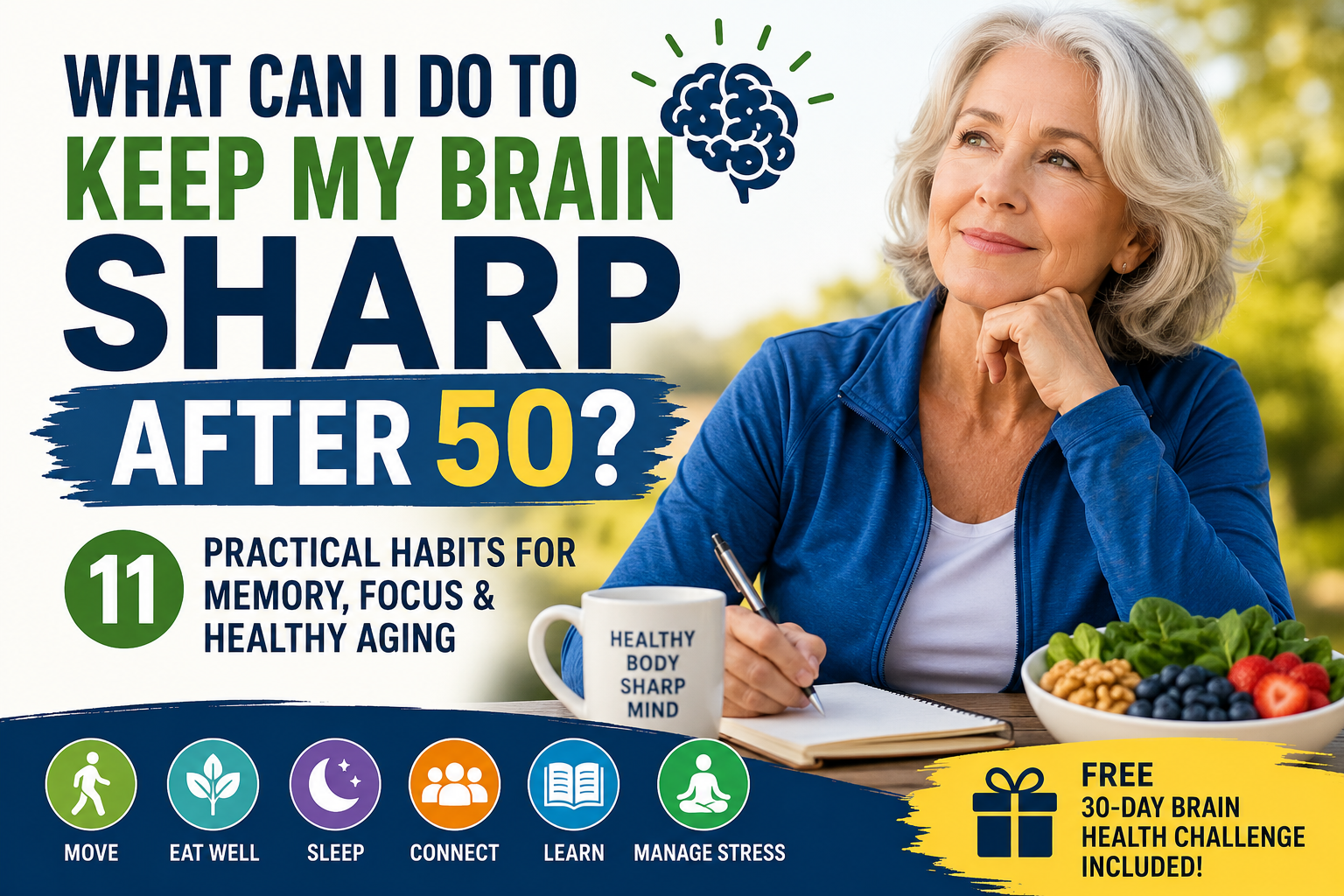
Discover 11 practical habits that can support memory, focus and healthy aging—plus a free printable 30-Day Brain Health Challenge.
What can I do to keep my brain sharp after age 50? It is a question many of us begin asking after forgetting a familiar name, misplacing our keys or walking into a room without remembering why we went there.
Those moments can be frustrating. They may even make you wonder whether your brain is beginning to decline.
Some changes in memory and processing speed can occur as we grow older. However, getting older does not mean you are powerless. Your daily choices can help support your ability to think, learn, focus and remember.
You do not need an expensive “brain booster” or a complicated routine. Physical activity, nourishing food, restorative sleep, social connection, new learning and good cardiovascular health all contribute to a brain-friendly lifestyle.
This guide explains 11 practical ways to support your brain after 50. You will also find a free printable 30-Day Brain Health Challenge near the end of the article. No email address or sign-up is required.
🧠 Welcome to TakesMassiveAction.com
If you are new here, this is a great place to start. This guide brings together practical habits that can support memory, focus and healthy aging after 50.
Estimated reading time: 12–15 minutes
Free resource: 30-Day Brain Health Challenge included
Quick Answer: What Can I Do to Keep My Brain Sharp After Age 50?
The most effective approach is to support your entire body rather than relying on one memory trick, puzzle or supplement.
Start with these brain-healthy habits:
☐ Move your body regularly.
☐ Include strength training each week.
☐ Eat leafy greens, berries, nuts, beans and other whole foods.
☐ Get seven to nine hours of sleep when possible.
☐ Learn skills that are genuinely new to you.
☐ Stay socially connected.
☐ Manage chronic stress.
☐ Take care of your blood pressure, cholesterol and blood sugar.
☐ Protect your hearing and vision.
☐ Avoid smoking and limit alcohol.
☐ Speak with your healthcare provider about persistent memory changes.
You do not have to do everything at once. Pick one checkbox, practice it consistently and build from there.
Table of Contents
- Is It Normal to Become More Forgetful After 50?
- 1. Learn Something That Is Genuinely New
- 2. Walk and Move Your Body Regularly
- 3. Include Strength Training
- 4. Eat a Brain-Friendly Pattern
- 5. Limit Foods That Work Against Overall Health
- 6. Treat Sleep as Essential Brain Maintenance
- 7. Stay Socially Connected
- 8. Reduce Chronic Stress
- 9. Protect Your Heart to Help Protect Your Brain
- 10. Do Not Ignore Hearing or Vision Changes
- 11. Be Skeptical of Brain-Boosting Supplements
- Seven Habits That May Be Aging Your Brain Faster
- A Simple Daily Brain Health Routine
- Seven-Day Brain-Sharpening Starter Plan
- Frequently Asked Questions
- Free 30-Day Brain Health Challenge
Is It Normal to Become More Forgetful After 50?
Occasionally forgetting where you placed an item or taking longer to remember a name does not automatically mean something is seriously wrong.
Stress, poor sleep, medication side effects, hearing difficulties, depression, dehydration and other health issues can all affect memory and concentration.
What matters is whether the changes are persistent, worsening or interfering with everyday life.
Talk with a qualified healthcare professional if you or someone close to you notices problems such as:
☐ Repeating the same questions frequently.
☐ Becoming confused in familiar places.
☐ Regularly missing important appointments.
☐ Struggling to manage familiar financial tasks.
☐ Having difficulty following ordinary conversations.
☐ Making decisions that are noticeably different from your usual behavior.
☐ Experiencing memory changes that disrupt daily independence.
Important: This article provides general educational information. It does not diagnose, prevent or treat dementia or any other medical condition. Seek professional medical advice about new, persistent or worsening symptoms.
1. Learn Something That Is Genuinely New
Crossword puzzles, word searches and familiar games can be enjoyable, but they become easier as your brain learns their patterns. To create a meaningful challenge, choose an activity that requires unfamiliar skills.
Good choices include:
☐ Learning basic phrases in another language.
☐ Taking music, painting or pottery lessons.
☐ Learning to use a new piece of technology.
☐ Trying a different style of cooking.
☐ Joining a class that requires active participation.
☐ Practicing a new dance or movement sequence.
The goal is not to master the activity immediately. The challenge of being a beginner encourages you to pay attention, solve problems and form new associations.
Today’s Brain Action: ☐ Choose one skill you have always wanted to learn and identify the first small step you can take this week.
2. Walk and Move Your Body Regularly
Physical activity supports more than your muscles and heart. It can also support thinking, learning, emotional balance and memory.
You do not need to begin with an exhausting workout. A brisk walk is one of the simplest ways to add more movement to your day.
A practical weekly goal for many adults is approximately 150 minutes of moderate activity. However, your starting point should match your current health, fitness and mobility.
Someone who is currently inactive might begin with five or ten minutes and gradually add time.
A Simple Four-Week Walking Progression
| Week | Walking Goal |
|---|---|
| Week 1 | Walk for 10–15 minutes on three days. |
| Week 2 | Walk for 15–20 minutes on four days. |
| Week 3 | Walk for 20–25 minutes on five days. |
| Week 4 | Work toward 30 minutes on most days. |
Use a comfortable pace and choose a safe, level route. Ask your healthcare provider about appropriate activity if you have chest pain, dizziness, balance problems, severe joint pain or a condition that affects exercise safety.
Today’s Brain Action: ☐ Take a 10- to 15-minute walk at a pace that feels comfortable and safe.
3. Include Strength Training
Muscle loss becomes more common as we age, but it is not something we should simply accept without taking action.
Strength training helps preserve the ability to stand, carry groceries, climb stairs and remain independent. Resistance exercise may also support aspects of cognitive function, especially when combined with regular aerobic activity and good sleep.
Beginner-friendly options include:
☐ Sitting down and standing up from a sturdy chair.
☐ Wall push-ups.
☐ Resistance-band rows.
☐ Light dumbbell curls.
☐ Supported calf raises.
☐ Carrying light weights while walking safely indoors.
Aim to work the major muscle groups about twice per week, allowing recovery between sessions. Proper form matters more than lifting heavy weights.
For more ideas, read 7 Healthy Habits After 50 That Add Years to Your Life.
4. Eat a Brain-Friendly Pattern, Not One “Miracle” Food
No single food can guarantee that you will avoid memory problems. A consistent eating pattern matters more than occasionally adding a so-called superfood.
The MIND eating pattern combines features of Mediterranean-style and DASH eating plans. It emphasizes vegetables—especially leafy greens—along with berries, whole grains, beans, nuts, fish and olive oil.
| Brain-Friendly Food | Simple Way to Use It |
|---|---|
| Leafy greens | Add spinach to eggs, soup or salad. |
| Berries | Add blueberries or strawberries to oatmeal or yogurt. |
| Nuts | Choose a small handful instead of highly processed snacks. |
| Beans | Use them in soups, salads, chili or tacos. |
| Fish | Replace one processed or fried meal each week. |
| Whole grains | Try oatmeal, quinoa or whole-grain bread. |
| Olive oil | Use it in salad dressings or for light cooking. |
Observational research has associated regular consumption of leafy green vegetables with slower cognitive decline, but that does not mean spinach by itself prevents dementia. Think of it as one useful part of a larger healthy pattern.
You may also enjoy Gut Health and Energy Over 50.
Today’s Brain Action: ☐ Add one serving of leafy greens, berries, beans or nuts to a meal today.
5. Limit Foods That Work Against Overall Health
A brain-friendly diet is not about banning every favorite food. It is about making nutrient-rich foods your normal choice and treating highly processed foods as occasional choices.
Consider reducing:
☐ Sugary drinks.
☐ Fried fast food.
☐ Highly processed packaged snacks.
☐ Excessive sweets and refined carbohydrates.
☐ Processed meats.
☐ Heavy alcohol consumption.
A useful rule: Add before you subtract. Add vegetables to lunch. Add beans to soup. Add berries to breakfast. As nourishing foods fill more of your plate, there is naturally less room for foods that provide fewer benefits.
6. Treat Sleep as Essential Brain Maintenance
Sleep plays an important role in attention, learning and memory. When you are sleep-deprived, ordinary forgetfulness can feel much worse.
Many adults need roughly seven to nine hours per night, although individual needs vary. Quality matters too. Spending eight hours in bed does not necessarily mean you received eight hours of restorative sleep.
Improve your sleep routine by checking off the habits that apply:
☐ Keep a reasonably consistent bedtime and wake time.
☐ Make the bedroom dark, quiet and comfortably cool.
☐ Reduce bright screens shortly before bed.
☐ Avoid large meals immediately before lying down.
☐ Limit late-day caffeine if it disrupts your sleep.
☐ Get morning daylight and daytime physical activity.
Talk with a healthcare professional if you snore loudly, stop breathing during sleep, wake with headaches or remain exhausted despite allowing enough time for sleep. Those may be signs of a treatable sleep problem.
Related reading: Why Am I Still Tired After Sleeping 8 Hours Over 50?
7. Stay Socially Connected
Conversation exercises attention, language, memory and emotional processing at the same time. Social connection can also reduce loneliness and give us a stronger sense of meaning.
Social activity does not need to mean attending a crowded event every night. Look for relationships and activities that feel comfortable and meaningful.
Try one of these:
☐ Call a friend you have not spoken with recently.
☐ Join a walking, gardening or book group.
☐ Volunteer for a cause you care about.
☐ Attend a community or faith-based activity.
☐ Schedule a regular lunch with friends or former colleagues.
☐ Help someone learn a skill you already know.
Teaching can be especially valuable because it requires you to organize information, recall details and explain ideas clearly.
Today’s Brain Action: ☐ Call, visit or send a message to someone whose company you enjoy.
8. Reduce Chronic Stress
Stress can make it harder to concentrate, retrieve words and form new memories. It may also interfere with sleep, exercise and food choices, multiplying its effects.
You cannot remove every stressful situation, but you can change how often your nervous system receives a chance to recover.
Experiment with:
☐ Five minutes of slow breathing.
☐ A quiet walk outdoors.
☐ Prayer or meditation.
☐ Writing worries and next steps in a journal.
☐ Gardening or another calming hobby.
☐ Listening to relaxing music.
☐ Reducing unnecessary notifications and news exposure.
If anxiety, sadness or stress is persistent and interfering with daily life, professional support can be an important part of protecting your overall health.
9. Protect Your Heart to Help Protect Your Brain
Your brain depends on a steady supply of oxygen-rich blood. That makes cardiovascular health an important part of cognitive health.
Work with your healthcare team to monitor and manage:
☐ Blood pressure.
☐ Cholesterol.
☐ Blood sugar.
☐ Body weight and waist measurement.
☐ Medication side effects and interactions.
☐ Smoking or tobacco use.
Do not stop or alter prescribed medication because of something you read online. Ask your physician or pharmacist to review your medications if you have noticed changes in alertness, concentration or memory.
Brain-Health Reminder: Habits that protect your heart—such as movement, balanced nutrition, adequate sleep and not smoking—also support the blood vessels that nourish your brain.
10. Do Not Ignore Hearing or Vision Changes
Hearing and vision help you remain engaged with conversations, reading, movement and the world around you.
When either becomes difficult, people may participate less, become more isolated or use extra mental effort simply to understand what is happening.
Schedule appropriate hearing and eye examinations, and use prescribed glasses or hearing devices consistently.
Take action if you notice:
☐ Frequently asking people to repeat themselves.
☐ Turning the television louder than others prefer.
☐ Avoiding restaurants or groups because conversation is difficult.
☐ Struggling to read familiar print.
☐ Experiencing new glare, blurred vision or blind spots.
☐ Feeling less confident while driving.
11. Be Skeptical of “Brain-Boosting” Supplements
Supplements are frequently marketed with dramatic language about memory, focus and mental clarity. Those claims may be much stronger than the available evidence.
A supplement can also interact with prescriptions or create unwanted side effects. “Natural” does not automatically mean harmless.
Before buying a memory supplement:
☐ Ask whether the claim is supported by high-quality human research.
☐ Look for unrealistic promises or guaranteed results.
☐ Review the ingredients with your physician or pharmacist.
☐ Check whether a diagnosed deficiency is actually present.
☐ Consider whether the money would be better spent on nutritious food, comfortable walking shoes or an activity class.
For most people, the strongest foundation is still movement, sleep, social connection, balanced nutrition and appropriate medical care.
Seven Everyday Habits That May Be Aging Your Brain Faster
Knowing what to do is important. It also helps to recognize patterns that may quietly work against your goals.
| Habit | A Better Choice |
|---|---|
| Sitting most of the day | Break up long periods of sitting with short movement sessions. |
| Sleeping too little | Protect a consistent sleep window instead of treating sleep as leftover time. |
| Repeating only familiar activities | Add challenges that require new skills and focused attention. |
| Living in isolation | Put recurring social contact on your calendar. |
| Relying heavily on processed food | Make whole foods the easy, visible choice at home. |
| Ignoring hearing or vision problems | Address changes before they cause you to withdraw from activities. |
| Believing nothing can change after 50 | Remember that starting small is far better than never starting. |
A Simple Daily Brain Health Routine After 50
Morning
☐ Drink a glass of water.
☐ Get a few minutes of outdoor light.
☐ Eat a nourishing breakfast with protein and colorful plants.
☐ Take a 10- to 30-minute walk.
Afternoon
☐ Stand and move after long periods of sitting.
☐ Eat vegetables, beans, nuts or berries.
☐ Spend 15 minutes learning or practicing a skill.
☐ Speak with someone whose company you enjoy.
Evening
☐ Write down tomorrow’s three most important tasks.
☐ Reduce bright screens and stressful content before bed.
☐ Read, stretch, pray, meditate or listen to calming music.
☐ Allow enough time for seven to nine hours of sleep.
Your Seven-Day Brain-Sharpening Starter Plan
Day 1
☐ Walk for at least 15 minutes.
Day 2
☐ Add one serving of leafy greens to a meal.
Day 3
☐ Call or meet someone you enjoy talking with.
Day 4
☐ Practice a genuinely new skill for 20 minutes.
Day 5
☐ Complete a short strength-training session.
Day 6
☐ Turn off screens early and protect your sleep routine.
Day 7
☐ Review your week and choose the habit you want to continue.
Frequently Asked Questions About Keeping Your Brain Sharp After 50
Can I really improve my brain function after 50?
You can continue learning, practicing new skills and improving many aspects of your physical and cognitive health after 50. No lifestyle guarantees protection from dementia, but healthy habits can support thinking, memory and overall well-being.
What is the best exercise for brain health after 50?
There is no single perfect exercise. A balanced routine normally includes aerobic movement such as brisk walking, strength training and activities that support balance and flexibility. The best routine is one you can perform safely and consistently.
Are crossword puzzles enough to keep my brain sharp?
Crossword puzzles can be enjoyable, but they should not be your only strategy. Combine familiar games with new learning, physical activity, social interaction, nourishing food and sufficient sleep.
What foods are best for memory after 50?
A brain-friendly pattern includes leafy greens, other vegetables, berries, nuts, beans, whole grains, fish and olive oil. Focus on the overall pattern rather than expecting one food to transform your memory.
How much walking should I do?
Many adults work toward about 150 minutes of moderate activity each week. Your appropriate amount depends on your current fitness, health and mobility. Begin with a manageable duration and increase gradually.
Does strength training help the brain?
Strength training supports mobility, independence and overall health. Research also suggests that physical activity may help maintain certain aspects of cognitive function. Combining resistance exercise with aerobic movement provides a well-rounded approach.
Can stress cause forgetfulness?
Yes. Stress can interfere with attention, sleep and the ability to retrieve information. Persistent memory concerns should still be discussed with a healthcare professional rather than being assumed to come from stress alone.
Can poor sleep make memory worse?
Poor sleep can affect concentration, learning, mood and memory. Seek medical advice when sleep problems persist or when loud snoring, breathing pauses or severe daytime sleepiness are present.
Is forgetting names a sign of dementia?
Occasionally struggling to recall a name is common and does not by itself diagnose dementia. Worsening changes that interfere with familiar daily activities deserve professional evaluation.
Should I take a supplement for memory?
Do not assume that a heavily advertised supplement is effective or safe. Discuss supplements with your physician or pharmacist, particularly if you use prescriptions or have an existing medical condition.
How quickly can I make my brain sharper?
You may notice improvements in energy, sleep or concentration after establishing healthier routines, but there is no universal timetable. Think in months and years rather than looking for an overnight transformation.
What is the most important brain-health habit?
Regular physical activity is one of the strongest places to begin, but brain health is best supported by a combination of movement, sleep, nutritious food, social connection, mental challenge and appropriate medical care.
🎁 Free 30-Day Brain Health Challenge After 50
Reading about healthy habits is useful. Practicing them is what creates change.
Download this free printable challenge and use the real checkboxes to track movement, nourishing food, learning, social connection, stress relief and sleep for 30 days.
Inside the Challenge
☐ Four weekly habit trackers
☐ Daily printable checkboxes
☐ Walking and strength goals
☐ Brain-friendly food reminders
☐ Weekly learning challenges
☐ Sleep and stress-relief tracking
☐ Progress reflections
No email required. No account. No sign-up.
Download the Free 30-Day Challenge
Download it, print it and start with Day 1 today.
Your Brain Is Listening to What You Do Every Day
Your brain does not need perfection. It needs repeated signals that you intend to keep moving, learning, connecting and caring for your health.
You Know Every walk is a signal.
Every nourishing meal is a signal.
And Every good night’s sleep is a signal.
Every conversation, new skill and strength-training session is a signal.
Do not try to transform your entire life by tomorrow morning. Choose one action from this article and complete it today.
Then do it again tomorrow.
That is how ordinary decisions become powerful habits—and how you begin taking massive action for your health after 50.
Choose Your First Action
☐ Take a 15-minute walk.
☐ Add leafy greens to your next meal.
☐ Call a friend.
☐ Set an earlier bedtime.
☐ Choose a new skill to learn.
☐ Download the free 30-Day Brain Health Challenge.
1 thought on “What Can I Do to Keep My Brain Sharp After Age 50?”